
Cambridge IELTS Academic 15 Writing Task 1 Model Answers
TEST - 1
The chart below shows the results of a survey about people's coffee and tea buying and drinking habits in five Australian cities.
Summarise the information by selecting and reporting the main features, and make comparisons where relevant.
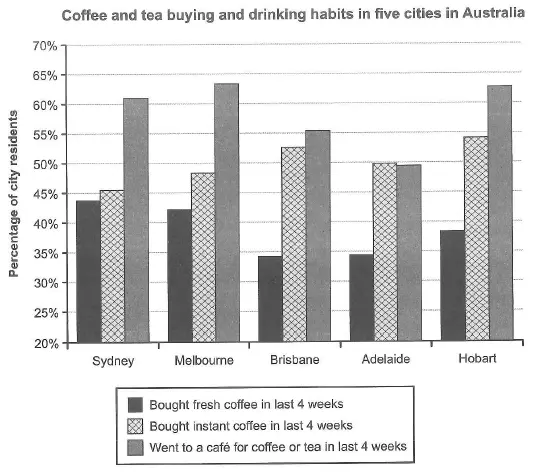
People’s drinking and buying habits of coffee and tea in Sydney, Melbourne, Brisbane, Adelaide and Hobart are depicted in a vertical bar graph. The data is taken from a survey.
Overall, a high percentage of people in most of the cities preferred to go to a cafe for tea or coffee in the last four weeks. Buying fresh coffee was not popular in all these Australian cities. Adelaide was the only city where more people bought instant coffee than going to a cafe to drink tea or coffee.
In Sydney, more than 60 per cent of people drank coffee or tea at a cafe in the last four weeks, while the fresh coffee buyers were low in proportion(less than 45 per cent). People who bought instant coffee during this time were just above 45 per cent. Fresh coffee and instant coffee buyers in Melbourne were above 40% and 45%, respectively. But cafe goers were higher than in all cities (just below 65 per cent).
Fresh coffee buyers in Brisbane and Adelaide were less than 35 per cent, which is the lowest proportion compared to other cities. Around 55% of people bought instant coffee and went to a cafe to drink tea or coffee in Brisbane. Adelaide is the only city where more people (50%) bought instant coffee than people went (less than 50%) to a cafe to drink tea or coffee in the last four weeks. As compared to other cities, instant coffee buyers in Hobert were more: around 55%. Fresh coffee buyers and cafe goers were less than 40 per cent and more than 60 per cent, respectively.
TEST - 2
The graph below shows the number of tourists visiting a popular Caribbean island between 2010 and 2017.
Summarise the information by selecting and reporting the main features, and make comparisons where relevant.
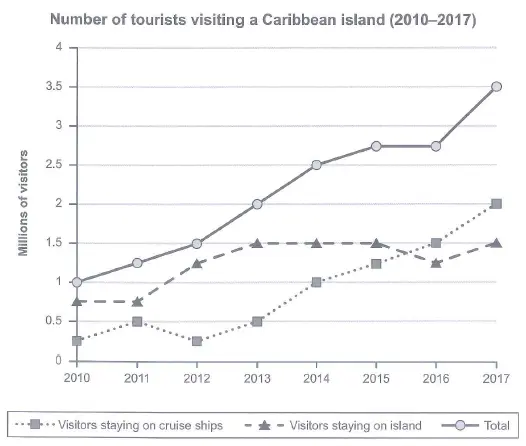
The number of visitors who visited a famous Caribbean Island from 2010 to 2017 is depicted in a line graph.
Overall, the total number of tourists visiting the island increased over the years. At the start of the period, more people stayed on the island than those who lived on cruise ships, but this trend became inverted in 2016. After 2013, people staying on cruise ships started increasing gradually.
One million visitors visited the island in 2010, which included less than 0.5 million staying on cruise ships and more than 0.5 million accommodated on the island. The number of tourists who lived on the island remained the same in 2011, but visitors who stayed on the cruise ship reached the exact number of 0.5 million. They again decreased in 2012. However, after that year, their number started increasing constantly and surpassed the number of visitors living on the island after 2015.
In 2013, visitors who visited and stayed on the island were 1.5 million, and their numbers remained the same until 2015. After falling in the next year(2016), the number of visitors staying on the island again reached 1.5 million. The total number of tourists visiting the island was 1.5 million in 2012, and it increased to more than 2.5 million in 2015 and remained the same in 2016. However, the island’s visitors spiked to 3.5 million in 2017.
TEST - 3
The diagram below shows how instant noodles are manufactured.
Summarise the information by selecting and reporting the main features, and make comparisons where relevant.
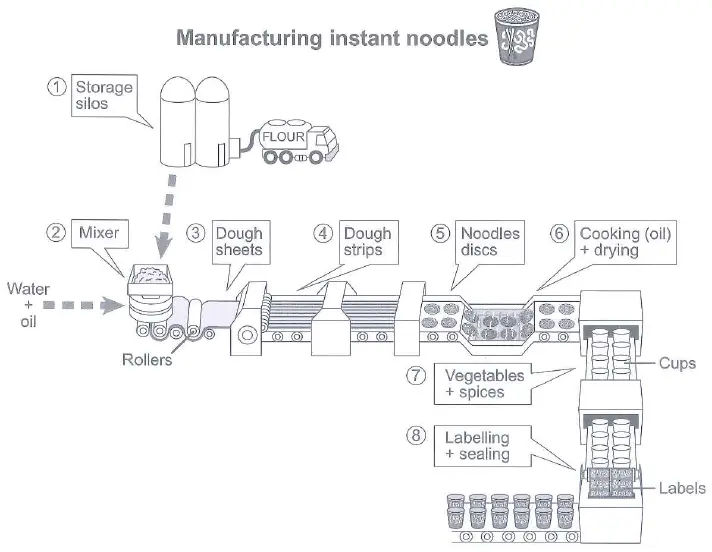
The manufacturing of instant noodles is shown in the given process diagram.
Overall, there are eight stages of the production of instant noodles. The process starts with storing the flour in silos and ends with the labelling and sealing of noodle cups that are ready to sell in the market. The whole manufacturing is carried out using a variety of machines that perform different tasks to make noodles.
In the first step, a truck transports the flour to storage silos. This flour is then brought to the mixer, where it is mixed with oil and water to make a dough. The dough is turned into dough sheets in the third stage. The next stage is to cut the dough sheets into dough strips, which obtain the shape of noodle discs in the fifth step.
Afterwards, noodle disks are cooked in cooking oil and then dried. Now, the noodles are ready to pack. So, in the seventh stage, noodles are packed in cups along with vegetables and spices. Finally, the eighth stage is the place where cups are sealed and labelled, which are ready for sale in the market.
TEST - 4
The chart below shows what Anthropology graduates from one university did after finishing their undergraduate degree course. The table shows the salaries of the anthropologists in work after five years.
Summarise the information by selecting and reporting the main features, and make comparisons where relevant.
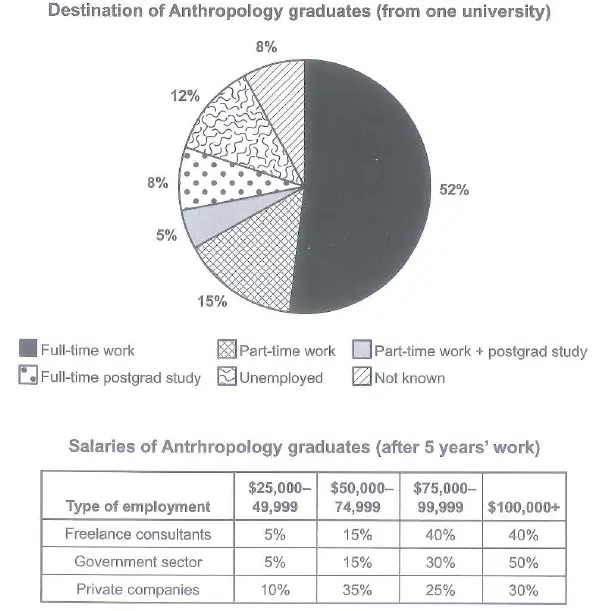
The pie chart shows what a university’s anthropology graduates decided to do after passing the undergraduate degree course. Their income after working for five years is shown in a table.
Overall, more than half of anthropology graduates started doing full-time work once they completed their degree course. The proportion of graduates who decided to do part-time work was more than other destination proportions but significantly less than the full-time workers’ percentage. The highest proportion of anthropologists working in the government sector earned the maximum amount.
Fifty-two per cent of anthropologists started doing full-time work once they completed their degree, which is the highest proportion. The proportion of graduates whose destination is unknown and who started doing full-time post-graduation study was the same(8%). The lowest proportion (5%) of graduates started doing part-time work and post-graduation study together. Fifteen per cent and 12 per cent of anthropology graduates started doing part-time work and remained unemployed, respectively.
After working for five years, 50% of anthropology graduates were earning more than $100,000 in the government sector, while 40% of freelancer consultants and 30% of anthropologists working in private companies were earning that amount. Freelancer consultants and anthropologists working in the government sector, 5% each, were earning the lowest amount ($25,000-49,999). The proportion of anthropologists working as freelancer consultants and in government sectors earning $50,000-74,999 were also the same:15%. However, anthropologists in this income slab and working for private companies were 35%. Anthropology graduates working as freelancers, working in the government sector, and private companies were 40%, 30% and 25%, respectively, who were earning between 75,000-99,999.