
Cambridge IELTS Academic 14 Writing Task 1 Model Answers
TEST - 3
The diagram below shows how electricity is generated in a hydroelectric power station.
Summarise the information by selecting and reporting the main features, and make comparisons where relevant.
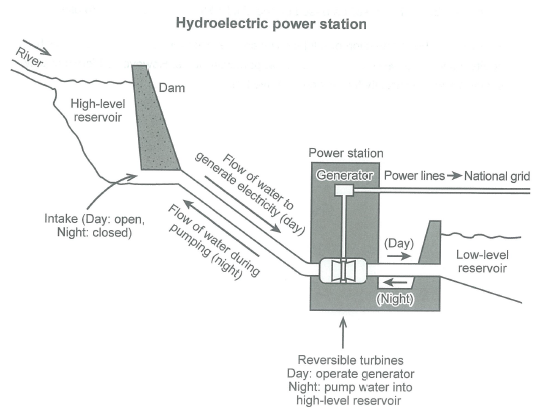
The generation of electricity in a hydroelectric power station is shown in the process diagram.
Overall, water from a river is used to produce electricity at the hydroelectric power station. The water flows in the opposite direction at night as it flows in the day. The turbine is the main component of the power station responsible for directing the flow of water and operating the generator to produce electricity.
Water from a river is stored at a high-level reservoir built using a dam. The stored water flows through the intake (opens in the day and closes at night) in the day towards the power station where the turbine is rotated, which operates the generator that generates electricity. The electricity generated by the generator is transmitted to the national grid through power lines.
After rotating the turbine, water flows to the low-level reservoir. At night, the turbine rotates in the reverse direction and pumps the water back to the high-level reservoir. This process repeats, and water flows again towards the power station to produce electricity.