
Cambridge IELTS Academic 12 Writing Task 1 Model Answers
TEST - 6
The maps below show the center of a small town called Islip as it is now, and plans for its development.
Summarise the information by selecting and reporting the main features, and make comparisons where relevant.
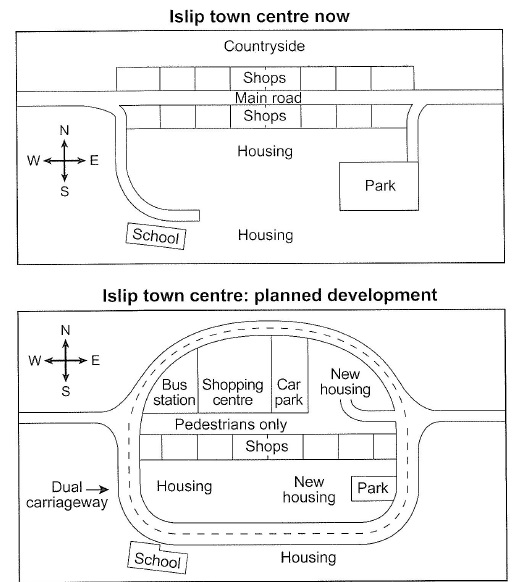
The current central layout and future development plan of a small town known as Islip are depicted in two maps.
Overall, it can be seen that the town will have many more facilities than now. The countryside area will be occupied by several developments. Also, the town will be surrounded by a dual carriageway.
Presently, the town has a series of shops on both sides of the main road that leads from the west to the east. Beyond the shops on the north side, there is the countryside area. The housing area is now only on the south side of the town. There is a big park on the southeast side of the town that can be accessed by a road leading from the main road.
In the future, all shops that are presently on the north of the main road will be replaced by a bus station, car park, shopping centre and new housing. The main road will be turned into a pedestrian-only path. The shops in the south will have no change. More housing facilities will be provided in this area. Where the school building will expand, the park size will be reduced. The whole town will be surrounded by a dual carriageway.
TEST - 7
The chart below shows how frequently people in the USA ate in fast food restaurants between 2003 and 2013.
Summarise the information by selecting and reporting the main features, and make comparisons where relevant.
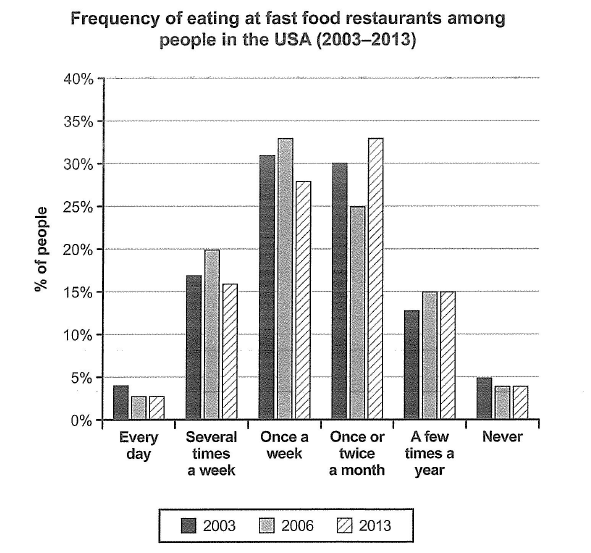
How often the people of the United States went to eat at fast food restaurants in 2003, 2006 and 2013 is depicted in a vertical bar chart. The data is given in percentages.
Overall, the proportion of people visiting fast-food restaurants once a week and once or twice a month was the highest. Never and every day goers were almost the same in all three years. The proportion was the same for people who went to fast food restaurants a few times a year in 2006 and 2013.
Less than 5 per cent of people were everyday goers to fast food restaurants in all three years(2003, 2006, and 2013). 20 per cent of people in 2006 went several times a week to fast food restaurants. For such people, the ratio was more than 15 per cent in 2003 and 2013. The proportion of people who ate at fast food restaurants once a week in 2006 and once or twice a month in 2013 was the same as well as the highest(well above 30 per cent). In 2003 and 2006, the proportion of people in this segment was around 25 and 30 per cent.
An equal proportion of people in 2006 and 2013 went to eat fast food at a restaurant in the United States: 15%. In 2003, five per cent of people never went to eat at fast food restaurants, whose ratio reduced to less than five per cent after three years and remained the same in 2013.
TEST - 8
The diagram below shows how geothermal energy is used to produce electricity.
Summarise the information by selecting and reporting the main features, and make comparisons where relevant.
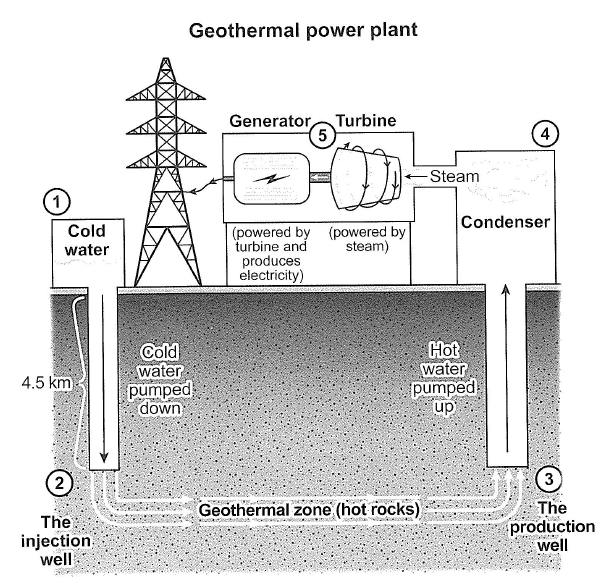
How geothermal energy is used to produce electricity is depicted in the given diagram.
Overall, in five stages, the electricity is produced using geothermal energy. Cold water acts as a fuel in this process. A turbine-powered generator produces electricity in the final stage.
The process of producing electricity using geothermal energy starts by storing cold water above the earth. This water is pumped 4.5km down into the earth. In the second stage, water reaches the injection well, where it is injected into the geothermal zone. Here, hot rocks heat the water, which is then reached to the third stage(production well).
In the fourth stage, water is put into a condenser. The condenser transforms the hot water into steam. The steam transfers to the fifth stage, and here, it empowers the turbine to rotate. The turbine, in turn, operates the generator. The generator is the equipment that produces electricity and transfers it to the power poles. Then, the electricity is further distributed.