
Cambridge IELTS Academic 19 Writing Task 1 Model Answers
TEST - 1
The graph gives information on the number of participants for different activities at one social centre in Melbourne, Australia for the period 2000 to 2020.
Summarise the information by selecting and reporting the main features, and make comparisons where relevant.

The line graph presents data on the number of participants involved in various activities at a community centre in Melbourne, Australia, over the two decades from 2000 to 2020.
Overall, over the two decades, participation in the film club remained the highest, though relatively stable. Midway through the period, the number of participants in amateur dramatics and table tennis was equal; however, table tennis saw a sharp rise in participation in subsequent years, while attendance in amateur dramatics declined significantly.
In 2000, over sixty people participated in the film club, though their numbers declined slightly by 2010. However, participation experienced a resurgence by 2020, surpassing the levels recorded in 2000. Meanwhile, no one participated in musical performances from 2000 to 2005, but by 2010, this activity saw a modest rise, with over ten participants. This gradual upward trend continued, reaching approximately 20 participants by 2020. Participation in martial arts fluctuated throughout the given period, but it consistently remained within the range of 30 to 40 members, reflecting a relatively stable trend despite the variations.
Fewer than 30 people participated in amateur dramatics, while table tennis had fewer than 20 participants in 2000. By 2010, participation in both activities aligned at 20 individuals. However, after 2010, the number of table tennis participants rose sharply, surpassing 50 by 2020, whereas participation in amateur dramatics dropped significantly to fewer than 10 by the same year.
TEST - 2
The plans below show a harbour in 2000 and how it looks today.
Summarise the information by selecting and reporting the main features, and make comparisons where relevant.
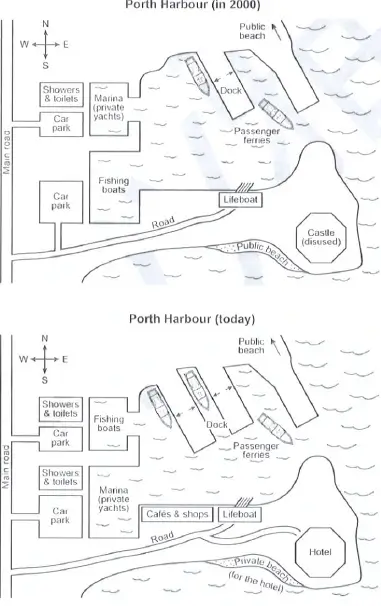
The differences in the layout of Porth Harbour between 2000 and the present are depicted in a map.
Overall, more facilities are now available at Porth Harbour compared to the past. A new hotel, cafés, shops, and an additional dock have been built in the harbour. No changes have occurred to the car parks, except for the road access to one car park.
The locations of the marina (private yachts) and fishing boats have been switched compared to the year 2000. The private beaches on the north-eastern and south-eastern sides of the harbour remain unchanged. A hotel has been built on the site of the disused castle, which also occupies some area in the sea near the south-eastern private beach. There are now two docks instead of one, as there were in 2000. Additionally, new cafés and shops have opened to the west of the lifeboat area.
Apart from that, new showers and toilets have been built to the north of the car park in the south. Previously, this car park was accessed by a road leading from the main road to the lifeboat area, but now it can be reached directly via the main road. The showers, toilets, and car park in the northwest of the harbour have remained unchanged during this period.
TEST - 3
The diagram below shows how a biofuel called ethanol is produced.
Summarise the information by selecting and reporting the main features, and make comparisons where relevant.
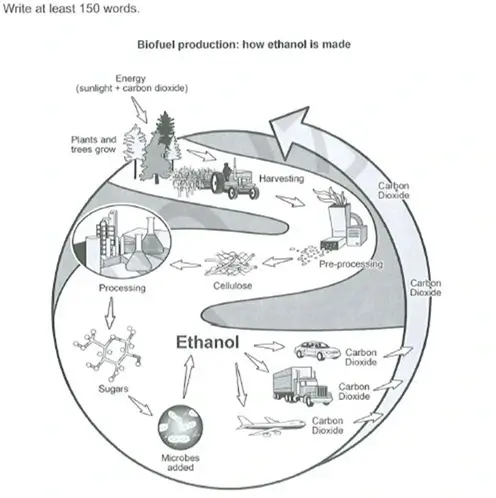
The stages involved in the production of ethanol, a type of biofuel, are illustrated in a process diagram.
Overall, the production process of ethanol begins with plant cultivation and concludes with its use as a biofuel in various modes of transportation. The main stages include harvesting and pre-processing the plants, producing ethanol through chemical processing, and utilizing ethanol in vehicles.
Plants and trees grow by obtaining energy from the sunlight and carbon dioxide. They are harvested and pre-processed using different machines. After pre-processing, cellulose is obtained from trees and plants. This substance is processed in a laboratory, and sugar is extracted.
Sugar is then added with microbes, and ethanol is produced. Ethanol is used by different vehicles, such as cars, trucks, and airplanes. After the burning of this biofuel by these vehicles, carbon dioxide is produced, which is released into the air. The carbon dioxide from the air, along with sunlight, is again absorbed by trees and plants, and this process starts again.
TEST - 4
The charts below give information on the location and types of dance classes young people in a town in Australia are currently attending.
Summarise the information by selecting and reporting the main features, and make comparisons where relevant.

The pie chart illustrates the venues where young people in an unidentified Australian town attend dance classes, while the horizontal bar graph presents the number of students from different age groups participating in various types of dance classes.
Overall, nearly half of the total proportion of dance classes in an unspecified town in Australia are attended by youngsters at private studios, while a small percentage of them choose college-based studios. Ballet dance is more popular style among children under 11, but modern dance is favored by those in the 11–16 age group.
The most popular location for attending dance classes among youngsters in the town is private studios, with 48% choosing this option. Nearly one-fifth of dance classes are held in school halls after school. Additionally, 18% of youngsters attend classes in community halls or other venues. The smallest proportion, 10%, attend classes in college-based studios.
The number of students under the age of 11 attending ballet dance classes is 600, while only half that number belongs to the 11–16 age group. Tap dance is equally popular among both age groups, with attendance ranging between 400 and 500 students from each group. Modern dance is particularly popular among the 11–16 age group, with over 500 students attending these classes, compared to 300 students from the under-11 age group.